Review: Modern Nature at Drawing Room | Wilma
Originally published 14th June 2019 on Wilma
From the meticulous botanical drawings of the conservationist Margaret Mee to the scientific presentations of conceptual artist Mark Dion, plants have captured the imagination of artists throughout time. Inextricably linked to the fate of human life, they offer both sustenance and crucial lessons in survival. An exhibition at Drawing Room in London brings together nine artists who explore botany through the prism of society, politics and scientific research and use drawing as a medium to reflect upon our relationship to plant life.
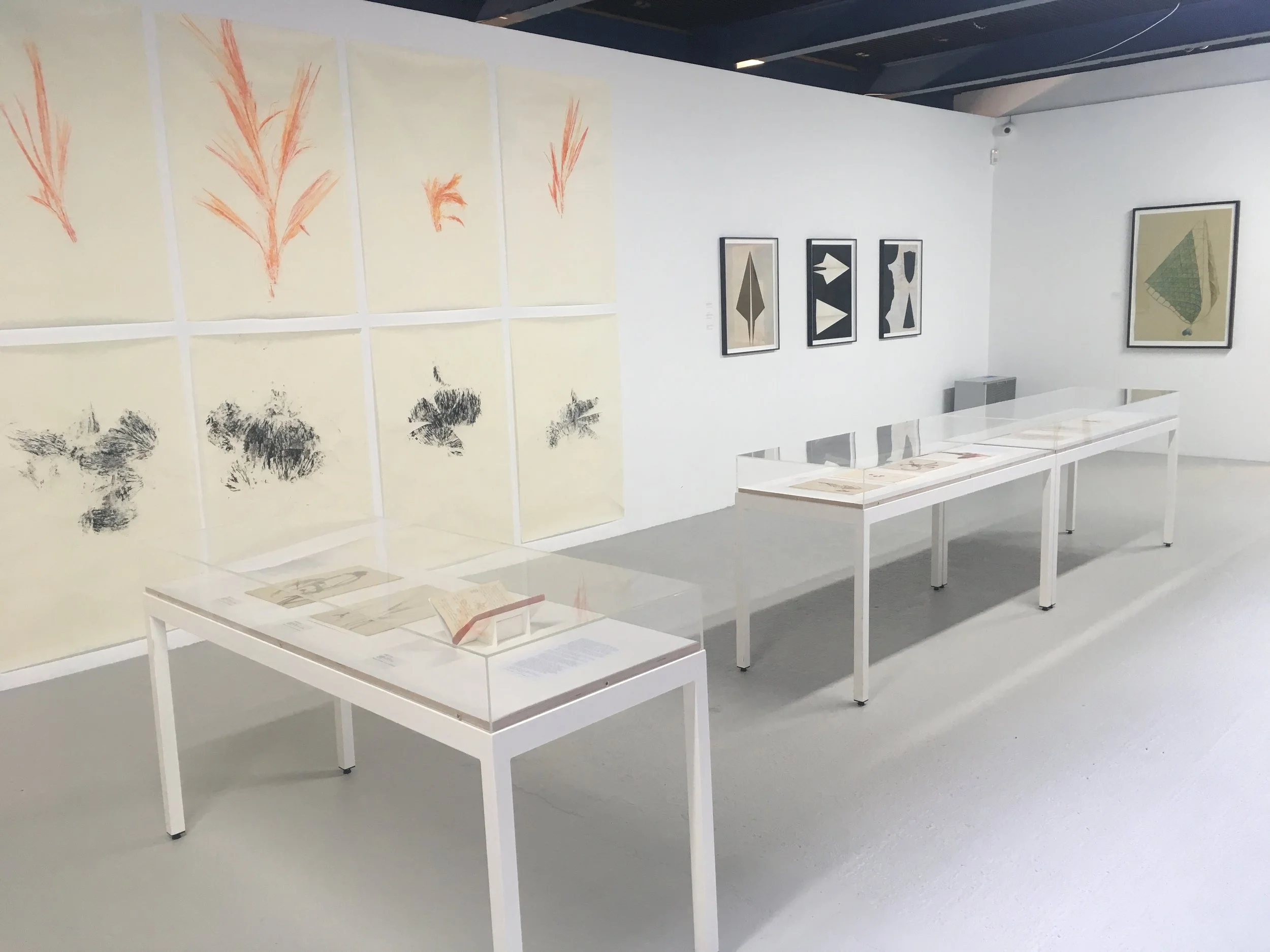
Taking its title from the diaries of artist and filmmaker Derek Jarman, Modern Nature draws attention to our interactions with plant life as influenced as their are by our cultural, society and personal histories. After discovering he was HIV positive in 1986, Jarman spent his remaining years in Dungeness finding solace in the desolate landscape. His diaries record his daily reflections and efforts to create a garden in the shadow of a nuclear power station. The ‘Garden Books’ displayed in the exhibition are preserved under glass, their pages open to reveal selected entries. The inky, cursive writing leaps out from the pages accompanied in places by the odd pressed flower or sketches of his garden.
Drawing predates photography as a means of studying plants and by its very nature, the medium encouraged a closer gaze. As botanical nomenclature developed, illustration became an important aid to identification. Margaret Mee, a British conservationist and botanical artist specialised in the flora of the Amazon Forest which she studied on numerous expeditions between the 1950s and 80s. Her illustrations are painstakingly rendered in gouache, capturing every curling tendril and soft petal with evident affection and played a crucial role in supporting her persistent efforts to draw attention to the disastrous effects of industrialisation in the region. David Thorpe also uses drawing to study plants, revisiting the style of botanical art in the 19th century. Thorpe renders his detailed plant studies in watercolour with a more idealised gaze and is inspired by the Arts and Craft Movement reinterpreting their forms with an emotional undertone and subtle sexual energy.
“Plants in their muteness have a mysterious beauty and can suggest rich inner lives that remain tantalising beyond our understanding.”
Elsewhere, Columbian artist Alberto Baraya employs a fictional approach, carrying out pseudo expeditions across the world. Baraya collects artificial plants and careful documents his finds, compiling them in his work Herbario de plantas artificiales; a collection of annotated botanical drawings hang beside staged photographs of specimens held by an anonymous hand at prominent landmarks documenting the site of their ‘discovery’. Mark Dion takes a similarly scientific approach often employing modes of scientific study to collate and present material in formal arrangements that speak to the precarity and threats facing our natural environment today.
Swedish artist Hilma af Klint, like many abstract artist of the late 19th and early 20th century, was interested in transcending the physical and sought a new language to visualise ideas of the unconscious. The botanical drawings shown here reveal an early stage in her practice as she developed her technique and observational eye. After 1906 her visual language would become increasingly abstract assuming a diagrammatical approach and Klint’s would shift her gaze beyond the living to the universal consciousness beyond.
Simryn Gill seeks a sense of connection between humans and the plant life to reveal the commonalities that could be key to our mutual survival in an uncertain future. In Travelling Light, 2017, Gill employs the plants themselves to illustrate this overlap, covering sprouting coconuts in paper coated in paint that are unwrapped to reveal unique ‘drawings’. The colourful streaks express both a sense of movement and freeze-frame on paper a life already lived. As the title suggests, the work is unburdened by the weight of its subject and captures if only in its crude textures, the essence of the plant left behind.
Christine Ödlund studied ecological chemistry and explores the space between science and metaphysics, moving between animations, drawings, sculptures and music. Her work Aspects of Linnaeus system of shape and colour I-III, draws inspiration from the work of the Swedish naturalist Carolus Linnaeus who developed a classification system based on their sex organs. Three large bold shapes in black float on a pale background of dots and lines resembling a constellation map of stars or blueprint, call to mind far away galaxies.
Plants in their muteness have a mysterious beauty and can suggest rich inner lives that remain tantalising beyond our understanding. Latvian artist Viktor Timofeev evokes a sense of the supernatural with his site-specific pastel drawing. Created in conté pastel crayons, Timofeev’s plants are over-sized and alien-like; their gnarly, dried-out forms rendered in shades of blood-red and blue. Emerging out a maze, they twist in place and at times pierce themselves in a strange acts of quasi-violence. Developed from smaller sketches, Timofeev explores the scientific through a lens of fantasy and the work hints at the dual nature of our relationship with plants.
Modern Nature reveals the rich and varied history of artistic exploration inspired by the power and beauty of plans and a poetic reminder of what we might learn from our silent counterparts. As the poet Robert Browning wrote in A Soul’s Tragedy in 1846, “I trust in nature for the stable laws of beauty and utility. Spring shall plant / And Autumn garner to the end of time.”